
Luxury Laundry Appliances for 2026 Remodels
Luxury Laundry Room Appliances in 2026: Front-Load Washers, Heat Pump Dryers, Steam Cycles, and Cabinet Planning
Models that suit your space, laundry habits, fabric-care needs, and utilities can be the best picks for luxury laundry appliances in 2026. For convenience, select your washer and dryer models prior to designing cabinetry to ensure proper access and reach to doors, hoses, vents, drainage, controls, and service areas.
A premium laundry room should allow for easier washing, drying, sorting, and folding. Front-load washers can accommodate both side-by-side and stacked configurations, while heat pump dryers can be used in spaces where an outdoor vent is not conveniently available. Additional features such as steam cycles, moisture sensors, automated detergent dispensers, and application alerts can all be worthwhile when they are compatible with the household’s laundry routine.
Consider appliance size, door swing, loading height, cycle options, noise, and installation needs when thinking of buying new appliances. Check product and installation guides before finalizing your cabinets, counters, plumbing, electrical work, and ventilation.
What Makes a Laundry Room Feel Luxury-Level?
A luxury laundry room is more than just high-priced appliances. It should incorporate a design that minimizes workflow disruptions, is quiet, contains ample and smart storage, and includes features that care for and preserve fabrics. Its design should also complement the overall design of the house.
A luxury laundry room design should incorporate elements that simplify sorting, washing, drying, folding, and storing clothes. Some of these elements include a folding station, hanging rail, sink, drawers, baskets, and closed storage areas. Additionally, design elements such as lighting, built-in appliances, and matching finishes can also create a clean and balanced look.
The location of a laundry room affects its design in many ways, such as layout, storage, noise control, planning utilities, selecting appliances, and even how the laundry room connects to the adjacent living spaces.
- Primary laundry room: This room should accommodate frequent family laundry with space for sorting, folding, and storage, plus space to handle large items.
- Upstairs laundry: This location requires careful planning for noise, floor support, drainage, protection for leakage, and service because the room is often close to bedrooms.
- Guest suite: A compact stacked washer and dryer unit is a viable laundry option in this space that makes the controls and laundry supplies easily accessible to guests.
- Secondary laundry zone: The secondary laundry area should be conveniently located near a pool, bedroom, guesthouse, or home gym. This reduces the need to travel to the main laundry room.
According to the needs of the household, luxury laundry appliancesmust provide functions appropriate for each household’s space. While features like gentle wash cycles, moisture sensors, and steam options may provide additional comfort, they only fulfill their purpose when used to meet daily needs.
Front-Load Washers, Top-Load Washers, and Capacity Planning
Both front- and top-load washers can provide consistent cleaning results, but each washer style supports specific layouts in a laundry room. When considering a washer, the homeowner should account for the space available, the comfort of their preferred loading style, the expected volume of laundry, and how they plan to use the surrounding space.
Front-Load Washers
A front-load washer has a front opening and uses a tumbling action to clean clothes. These washers can be placed under a counter with folding doors or stacked with a matching dryer with the stacking kit provided by the manufacturer.
The front door means the user may have to bend while loading and unloading. A compatible pedestal can raise the washer to a more convenient height. They may even provide extra storage, but it also changes the total appliance height and cabinet plan.
Top-Load Washers
Top-load washers feature open lids, which might be easier to use for individuals who prefer loading clothes while standing. However, top-load washers require space to open the lid, which restricts the construction of counters, shelves, and cabinets on top of the washer.
Top-load models either contain an agitator or an impeller. Buyers should look at wash action, drum access, controls, and cycles rather than appearance when making a choice.
Capacity and Household Laundry Volume
Washer capacity should match the household’s usual laundry habits. This includes family size and how much laundry gets done per week, as well as whether the washer needs to handle bedding, towels, uniforms, sportswear, or delicates.
Avoid choosing washer capacity based on terms such as compact, large, or extra-large. Look at the specifications for the washer and see if the matching dryer can hold a full load of your household laundry without being overstuffed.
Heat Pump, Vented, and Ventless Dryers
The ideal dryer is a combination of the room layout, available utilities, venting options, energy goals, and the household laundry needs. When comparing premium dryers, homeowners should understand that the vented, ventless condenser, and heat pump models remove moisture differently. They all have their own unique ways of removing moisture. These differences also affect drainage, airflow, power consumption, and installation, as well as service access.
Heat Pump Dryers
A heat pump dryer removes moisture from the drum air, heats that air, and then recirculates it, rather than releasing it. It is a closed-loop design, meaning it is ventless. The moisture it removes is drained to an external drain or tank, depending on the model.
According to the ENERGY STAR dryer guidance, certified heat pump dryers use about 70% less energy than a conventional clothes dryer. Heat pumps usually use lower temperatures and help with gentle fabric care, but with longer cycle times.
Furthermore, consider the initial price, cost of electricity, maintenance, the need for drainage, and the space you have. Miele laundry appliances exemplify how various features, such as heat pump drying, moisture sensing, and their connected control and stacking capabilities, can be integrated into a compact space
Vented Dryers
A vented dryer uses a duct to exhaust warm, moist air to the outdoors. Although a vented dryer can be electric or gas-powered, precautions must be made to ensure an approved and safe path of travel for the duct and dryer’s tempering airflow in accordance with the local codes.
A licensed professional must evaluate the vented dryer route, duct, airflow, outside termination, tempering airflow, and any service work before the final installation of the dryer.
Ventless Condenser Dryers
The design of a ventless condenser dryer lets it collect moisture inside, rather than releasing it outside of the unit. The collected moisture is redirected to a drain or a tank, depending on the design and installation.
This design is more convenient than a traditional dryer and works well in small spaces, such as condos or single-story apartments that have a difficult exterior dryer vent path. Drainage, room airflow, service access, power, and clearance rules still apply.
Steam, Sanitize, Auto-Dosing, and Smart Features
Premium features are only useful when they address existing laundry problems. The names and results of premium washer dryer features vary by brand and model, so buyers should review the cycle guide and care-label limits before buying.
Steam refresh
A steam washer and dryer may provide cycles to relax wrinkles or refresh particular items. Steam cannot be a substitute for full washing for items that are dirty or stained.
Sanitize Cycles
These cycles are designed for particular items that can be washed or dried under specific operating conditions. Check the instructions, the fabric care label, the guide label, and the model’s listing (if available) for the specific steps to sanitize your item, rather than assuming everything is the same.
Automatic Detergent Dosing
An auto-dose system is a design that stores detergent in the machine and releases the appropriate amount of detergent based on the wash cycle or a sensor that detects the load size. It is a design to eliminate the need to measure detergent each time, but it requires the right detergent, setup, cleaning, and refill routine.
Moisture sensing
Sensors can stop or adjust the drying process when the desired level of dryness is achieved. ENERGY STAR claims that automatic termination decreases energy consumption while preventing damage to fabric caused by over-drying.
App alerts
Connected washers and dryers can send updates, notify you when a cycle is complete, and suggest when the appliance needs maintenance. Different models have different features and requirements; they usually need a Wi-Fi connection or app and may even need manual activation on the appliance.
Specialty cycles
Labels on fabric give the first indication of how to care for items. As such, matching programs for items like wool, sportswear, bedding, or delicates should be considered, if they complement the wardrobe.
Prioritize features that will be used most often. Every machine has its controls and cycle list, different detergent and filter systems, and an associated app. Ask to see the controls, cycle list, detergent system, filter access, and app before deciding.
Cabinetry, Utility, and Clearance Planning
Prior to finalizing cabinet drawings, homeowners should select the appliances. Machines of the same size can vary in terms of door style, positioning of hoses, controls, vents, openings, and overall depth. Follow the current model and approved accessories guide when planning cabinet work. Don’t base work on outside dimensions alone.
Plan the Utilities First
Confirm the location of water, hose, shut-off, and drain provisions, access to power, and any gas connection with the relevant trades. A steam dryer requires water, and a ventless dryer may require a drain or an accessible supply of water.
The electrical and gas requirements may differ. Trades responsible for the work must confirm the requirements and local codes. Outlets, valves, and drains should remain accessible.
Check Venting and Airflow
Plan the full route for the duct for a vented dryer before closing off walls or cabinets. Follow the model guide and local regulations for the duct and outside termination. For a ventless model, follow the room-air and closet-opening instructions. Also, keep access to the filter and condenser clear.
Allow for Doors, Hoses, and Service
Measure the room, opening, delivery path, and final location. Include doors, hoses, plugs, vents, drains, trim, baseboards, and pedestals. Appliance doors and cabinet doors should not collide with each other. Don’t forget to leave some space so that connections remain accessible and the appliance can be removed when needed for service or repair.
Build Around the Approved Layout
Install the washer and dryer according to the installation guide. For a stacked pair, use the approved combination of stacking kit and appliance from the manufacturer. The washer sits beneath the dryer; however, the approved position for the model selected by the buyer may be different.
The cabinets and counters must allow the required airflow, utility access, door movement, and service space with no obstructions. Do not block water shutoff valves, drains, outlets, vents, filters, detergent drawers, or access panels. Make sure that all of these requirements are met prior to starting any cabinet work.
Luxury Laundry Appliance Comparison
| What Are You Choosing? | Main Options | How the Choice Affects Your Laundry Room | What to Check |
| Washer style | Front-load or top-load | A front-load washer may fit below a counter or work in a stacked pair. A top-load washer needs clear space above the lid. | Consider loading comfort, door or lid movement, capacity, pedestal height, and the amount of laundry your household handles. |
| Dryer style | Vented, ventless condenser, or heat pump | A vented dryer sends moist air outdoors. Ventless and heat pump dryers do not need an outdoor exhaust duct, but they still need proper moisture and drainage planning. | Review the vent route, power supply, drainage needs, water tank, filter care, cycle length, and installation guide. |
| Added features | Steam, sanitize, auto-dose, moisture sensing, or app alerts | These features can make laundry care easier, but they offer better value when they suit clothes and routines already common in the home. | Make sure the chosen model includes the feature and check how it works before paying extra for it. |
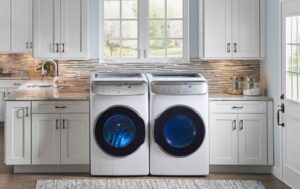
| Appliance position | Side by side, stacked, or raised on pedestals | Side-by-side machines may support a folding counter. Stacking saves floor space, while pedestals can raise approved models to a more comfortable height. | Check door swing, control height, cabinet space, approved accessories, airflow, utility access, and room for future service. |
| Buying process | Online research and showroom visit | Online details help narrow the choices, while a showroom visit allows buyers to check controls, doors, loading height, filters, and overall ease of use. | Take room measurements, utility details, cabinet plans, and a list of the features your household will actually use. |
Frequently Asked Questions
Are luxury laundry appliances worth it?
Yes, luxury laundry appliances can be a worthwhile investment when they meet a family’s day-to-day needs, including fabric-care cycles, quieter operation, controls, flexible layouts, available space, and budget.
Is a heat pump dryer better than a vented dryer?
Yes, a heat pump dryer can be better for energy savings and a ventless installation. However, a vented dryer may have faster drying cycles, depending on the model and existing laundry setup.
Should I stack my washer and dryer or place them side by side?
Yes, you can stacka washer and dryer to save space for additional storage. However, placing washer and dryer systems side by side creates space for a folding surface on top.
What should I measure before buying premium laundry appliances?
Before buying premium laundry appliances, make sure to measure the opening, depth, doorway, delivery route, door swing, and working area. Also confirm the locations of utilities, vents, airflow, stacking clearances, and service access.
Plan Your Laundry Room with Universal Appliance and Kitchen Center
Check out washers, dryers, matching pairs, pedestals, and stackable laundry options on UAKC.com. Viewing these options prior to visiting a showroom can give you an idea of the available appliance styles, methods of drying, helpful features, and layout options that can fit your household’s laundry needs on a routine basis.
You can also visit or contact Universal Appliance and Kitchen Center. Our staff will be happy to help you compare styles of washers and types of dryers regarding the designs of doors and controls, fabric care cycles, and the overall layout and installation of the units for your space.
Remember to bring your room measurements, cabinet plans, the locations of your utilities, and the details of the appliances you are considering. Before purchasing new cabinets, or before you change the connections of water, drain, gas, electricity, or vent, be sure to consult a qualified professional to verify that you have complied with local regulations and review the final installation guide.
- Front Load vs Top Load Washers: Which Laundry Setup Fits Your Home?
- Appliance Rebates in 2026: How to Compare Brand Promotions Without Buying the Wrong Package
- Luxury Appliance Packages in 2026: How to Match Your Refrigerator, Range, Dishwasher, and Ventilation
- Luxury Laundry Appliances for 2026 Remodels
- Wall-Mounted vs. Deck-Mounted Tub Fillers: Luxury Bathroom Fixture Planning in 2026
- Trash Compactors and Recycling Cabinets: Hidden Kitchen Cleanup Zones for Luxury Remodels in 2026
- Outdoor Hoods for Covered Patio Kitchens
- Column Freezers vs Upright Freezers
- Hood Inserts vs Statement Range Hoods
- Quiet Dishwashers for Open-Concept Luxury Kitchens: dBA Ratings, Drying Systems, and Panel-Ready Design in 2026